How to buy copper futures amid the green energy shift
A one-tick move in COMEX copper is $12.50. A one-tick move in LME copper is also $12.50. The contract exposure is not the same. Neither is the delivery system, currency basis, contract month structure, or clearing path.
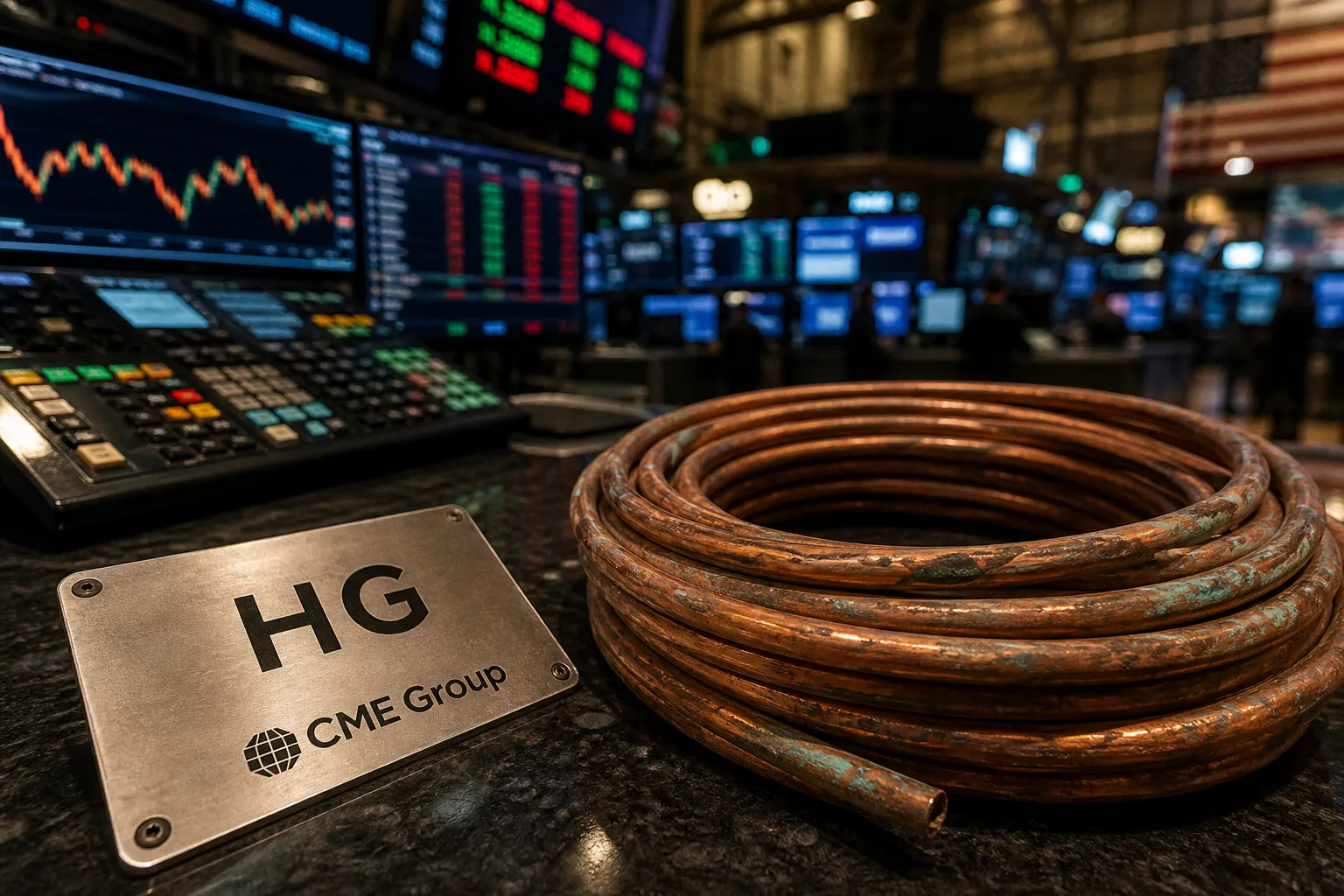
That is the first constraint in how to buy copper futures. The trade is not “buy copper.” It is buy a dated contract, post margin, absorb mark-to-market variation, and exit before a delivery mechanism becomes your problem.
Copper demand is projected to rise more than 40% between 2023 and 2040. Clean-energy applications could triple their copper requirement by 2040. EVs use up to four times the copper of combustion-engine vehicles across motors, batteries, wiring, and charging systems. These figures create a macro narrative. They do not create a futures entry.
Futures trade term structure, open interest, basis, collateral, and time.
Copper exposure is not a metal thesis. It is a contract-month thesis with leverage attached.
Start with the contract, not the chart
The first decision is venue. US traders usually reach copper through COMEX. Global physical-market participants often use the LME. Both list physically settled contracts. Both require an exit plan before first notice or delivery dates.
COMEX High Grade Copper futures trade under the ticker HG. One contract represents 25,000 pounds of copper. The minimum price increment is $0.0005 per pound. That converts to $12.50 per tick.
LME Copper trades under the CA contract. One contract represents 25 metric tonnes of Grade A copper. The electronic minimum tick is $0.50 per tonne. Again: $12.50 per tick.
The tick value matches. Exposure does not.
| Parameter | COMEX Copper (HG) | LME Copper (CA) |
|---|---|---|
| Contract unit | 25,000 pounds | 25 metric tonnes |
| Settlement | Physical | Physical |
| Minimum tick | $0.0005 per pound | $0.50 per tonne |
| Tick value | $12.50 | $12.50 |
| Delivery network | US locations | 34 approved warehouse locations globally |
| Core use case | US futures access, dollar pricing | Global physical basis, warehouse and delivery exposure |
COMEX pricing is quoted in US dollars per pound. LME pricing is quoted in US dollars per metric tonne. A trader comparing screens without converting units is not comparing the same price.
The rough conversion is mechanical: one metric tonne equals 2,204.62 pounds. Divide an LME dollar-per-tonne price by 2,204.62 to create a dollar-per-pound reference. Then account for timing, nearby-month basis, warehouse location, financing, and contract specifications. The residual is not noise. It is the market.
For most accounts, the route is:
1. Open a futures-enabled account with a broker clearing the relevant exchange product.
2. Apply for futures permissions and acknowledge commodity-risk disclosures.
3. Fund the account above both initial margin and a reserve for variation margin.
4. Select the contract month. Do not default to the front month.
5. Use a limit order if the order book is thin or the spread is wider than expected.
6. Set an exit protocol before entry: price level, time stop, or structure break.
7. Close or roll the position before the broker’s delivery cutoff.
“Buying copper contracts” means buying a specific month. A May contract and a December contract can express different trades even when both are HG.
The green-energy figure is a long-dated input, not a signal
The 40% demand-growth estimate through 2040 belongs in a structural file. It does not define whether the next liquid futures month should trade higher or lower.
Futures prices discount paths. A demand estimate can coexist with contango, backwardation, falling open interest, or a basis dislocation. The screen does not wait for 2040.
The useful question is narrower: what is the curve pricing now?
Contango: carry is in the price
Contango means deferred contracts trade above nearby contracts. For a long futures position, rolling from an expiring nearby month into a deferred month may require buying the next contract at a higher price.
That roll cost matters for any trader holding exposure over multiple expiries.
Contango can reflect financing, storage, insurance, warehouse economics, and inventory availability. It does not automatically negate a long view. It changes the carry arithmetic.
Backwardation: nearby scarcity is in the price
Backwardation means nearby contracts trade above deferred contracts. A long rolling position may receive positive roll yield if the curve shape persists.
But backwardation is not a direction instruction. It can flatten. It can invert. A nearby tightness signal can disappear before a trader reaches the next roll date.
For copper, monitor:
- The front-versus-second-month spread on COMEX.
- Nearby-versus-three-month structure on the LME.
- Open interest during price expansion or contraction.
- Volume migration from the expiring month into the next liquid month.
- The US-dollar-per-pound versus dollar-per-tonne conversion spread.
- LME warehouse inventory changes as a positioning input, not a standalone trade trigger.
The 17-year average path from greenfield discovery to production is also a structural input. It describes project latency. It does not establish that the next futures settlement must rise. Futures can reprice on rates, dollar moves, inventory flows, recycling, positioning, and curve carry long before a mine reaches production.
A 17-year mine timeline can shape the far curve. It cannot protect a leveraged long from a one-session repricing.
Margin is the trade’s first price
Copper futures are margined instruments. The buyer does not pay the full notional value upfront. The buyer posts initial margin, often around 10% to 12% of notional value, subject to exchange and broker adjustments.
That is leverage. It is not a discount.
Take COMEX HG. The contract controls 25,000 pounds. Every $0.01-per-pound move changes the contract’s value by $250.
The arithmetic:
- $0.0005 per pound: $12.50.
- $0.01 per pound: $250.
- $0.10 per pound: $2,500.
- $0.20 per pound: $5,000.
A trader can be correct on a six-month copper thesis and still fail the margin path in week one. Futures accounts settle gains and losses through variation margin. Losses reduce available capital. If equity falls below maintenance requirements, the broker can demand funds or reduce the position.
Margin requirements change. Broker house margins can exceed exchange minimums. Requirements can rise when realized volatility, event risk, or spread instability rises. A position sized from a prior margin screen may be oversized after a margin revision.
The usable capital calculation is not:
account balance / initial margin
It is closer to:
- Initial margin per contract.
- Maintenance margin per contract.
- Maximum expected adverse move.
- Number of contracts.
- Liquidity reserve.
- Correlation with other metal, equity, or dollar positions.
- Roll and transaction costs.
A trader allocating nearly all account equity to initial margin has not created buying power. The trader has removed the buffer required for the contract to function.
Copper market leverage compounds through unit size. HG controls 25,000 pounds. A small price move is multiplied across the whole unit. This is why trade size belongs before trade direction.
Micro Copper changes unit risk, not market risk
CME Micro Copper futures trade under MHG. The contract represents 2,500 pounds, one-tenth of standard HG.
The micro contract addresses unit size. It does not remove futures mechanics.
At 2,500 pounds:
- A $0.0005 tick equals $1.25.
- A $0.01-per-pound move equals $25.
- A $0.10-per-pound move equals $250.
- A $0.20-per-pound move equals $500.
This creates a cleaner position-sizing tool. A trader who needs 0.2 of an HG contract cannot trade 0.2 HG. The choice is one standard contract or zero. MHG introduces intermediate exposure.
| Exposure choice | Copper controlled | Value of a $0.01/lb move | Use case |
|---|---|---|---|
| 1 MHG Micro Copper | 2,500 pounds | $25 | Position sizing, execution practice, spread testing |
| 1 HG Copper | 25,000 pounds | $250 | Standard COMEX futures exposure |
| 2 HG Copper | 50,000 pounds | $500 | Larger directional or hedge exposure |
The micro contract also makes scaling possible. A trader can enter one unit, add only if the trade structure holds, or reduce exposure without closing the full thesis. But scaling does not repair a trade entered against curve deterioration or a volatility expansion.
Liquidity must still be checked contract by contract. A narrow displayed spread does not guarantee depth at size. Watch bid and ask quantity, recent volume, and the difference between the active month and deferred months. A market order in a thin deferred contract can turn a small sizing decision into an execution problem.
Do not import token-market logic from a Polygon OUSD launch. Copper futures are exchange-cleared contracts with daily variation margin, defined delivery rules, and expiry dates. The instruments do not share a risk model.
How to read positioning without inventing a forecast
Open interest is a ledger of outstanding contracts. It is not a sentiment meter by itself.
Price rising with rising open interest can indicate new long and short participation. Price falling with rising open interest can indicate new short and long participation. Neither observation reveals which side is trapped without additional data.
The practical read is relational:
- Price up, open interest up: participation expands. Check whether the nearby spread widens, flattens, or remains unchanged.
- Price up, open interest down: positions are closing. The move may be driven by short covering, long liquidation reversal, or both.
- Price down, open interest up: participation expands on the downside. Monitor strike concentration and nearby liquidity.
- Price down, open interest down: exposure leaves the contract. The move may lack fresh futures participation.
Options activity can alter futures behavior near major expiries. Large open-interest concentrations at strikes can pull hedging flows toward a level or create acceleration when the level fails. That is gamma mechanics, not a price prophecy.
For a futures buyer, the sequence is functional:
1. Identify the active contract month and its expiry calendar.
2. Map the nearest liquid option expiry.
3. Locate high open-interest strikes if the data feed provides them.
4. Compare futures volume and open-interest change with the prior sessions.
5. Check the front spread against the next month.
6. Enter only when the position size survives a defined adverse range.
7. Reassess after expiry, rollover, or a material curve change.
The green-energy shift is often discussed as if copper trades on a single demand line. The futures market does not. It trades dates. A June contract can react to nearby basis while a December contract reacts to financing and inventory assumptions. The chart is only one layer.
Delivery is a rule set, not an investment feature
Both COMEX HG and LME CA are physically settled. That fact matters even for traders who never intend to receive metal.
Retail brokers often impose earlier liquidation deadlines than the exchange’s formal delivery timeline. The broker does this to avoid customers entering a delivery obligation. A trader who waits for the final exchange date may already be past the broker’s cutoff.
COMEX delivery is tied to approved US locations. LME delivery runs through a global network of 34 approved warehouse locations. This does not mean a futures account provides simple access to industrial copper units. Delivery involves warrants, location, storage, load-out, quality specifications, financing, and operational arrangements.
For most speculative accounts, the relevant delivery rule is simple: exit or roll before the broker forces the issue.
Rolling means closing the expiring long and opening a later-dated long. The execution can be done as two outright orders or as a calendar spread, depending on broker tools and liquidity. The cost or credit comes from the curve.
A roll is not neutral. If the market is in contango, a long may repeatedly pay to maintain exposure. If the market is in backwardation, the roll may provide a credit. Neither state is permanent.
This is where many “long-term copper” positions fail their own accounting. The trader tracks the spot-like chart. The account experiences futures rolls, margin debits, spreads, commissions, and slippage.
The execution map: price, curve, expiry
A copper futures entry needs three maps.
The first is price. Define the invalidation level before entry. A stop can be price-based or structure-based, but it must translate into a dollar risk per contract.
The second is curve. A long in a flattening backwardation or steepening contango has different carry exposure from a long in a stable curve. Monitor the spread, not only the outright.
The third is expiry. Futures volume migrates. Options gamma decays. Delivery risk approaches. A contract can remain open on the screen while becoming inefficient for a new trade.
A clean operating frame looks like this:
- Buy the contract month with the required liquidity horizon.
- Size from dollar risk per tick, not from available margin.
- Keep a cash buffer above maintenance requirements.
- Track nearby and deferred spreads after entry.
- Monitor open-interest change with price, not in isolation.
- Know the broker’s liquidation date.
- Roll before liquidity exits the contract, not after.
- Recalculate exposure after every contract roll.
The key levels are not universal price numbers. They are the entry level, invalidation level, nearest high-open-interest strike, front-month spread threshold, and expiry date. Each belongs on the order ticket before the position is live.
Copper futures can express an industrial-metals view with precision. The precision cuts both ways. HG offers 25,000 pounds of exposure. MHG reduces the unit to 2,500 pounds. LME adds a global delivery framework. None converts a 2040 demand projection into a low-risk trade.
The screen settles each day. So does the leverage.