Lithium Market Shifts: Why the Battery Metal Glut Matters
Lithium carbonate no longer trades like a scarcity contract. It trades like inventory with a bid.
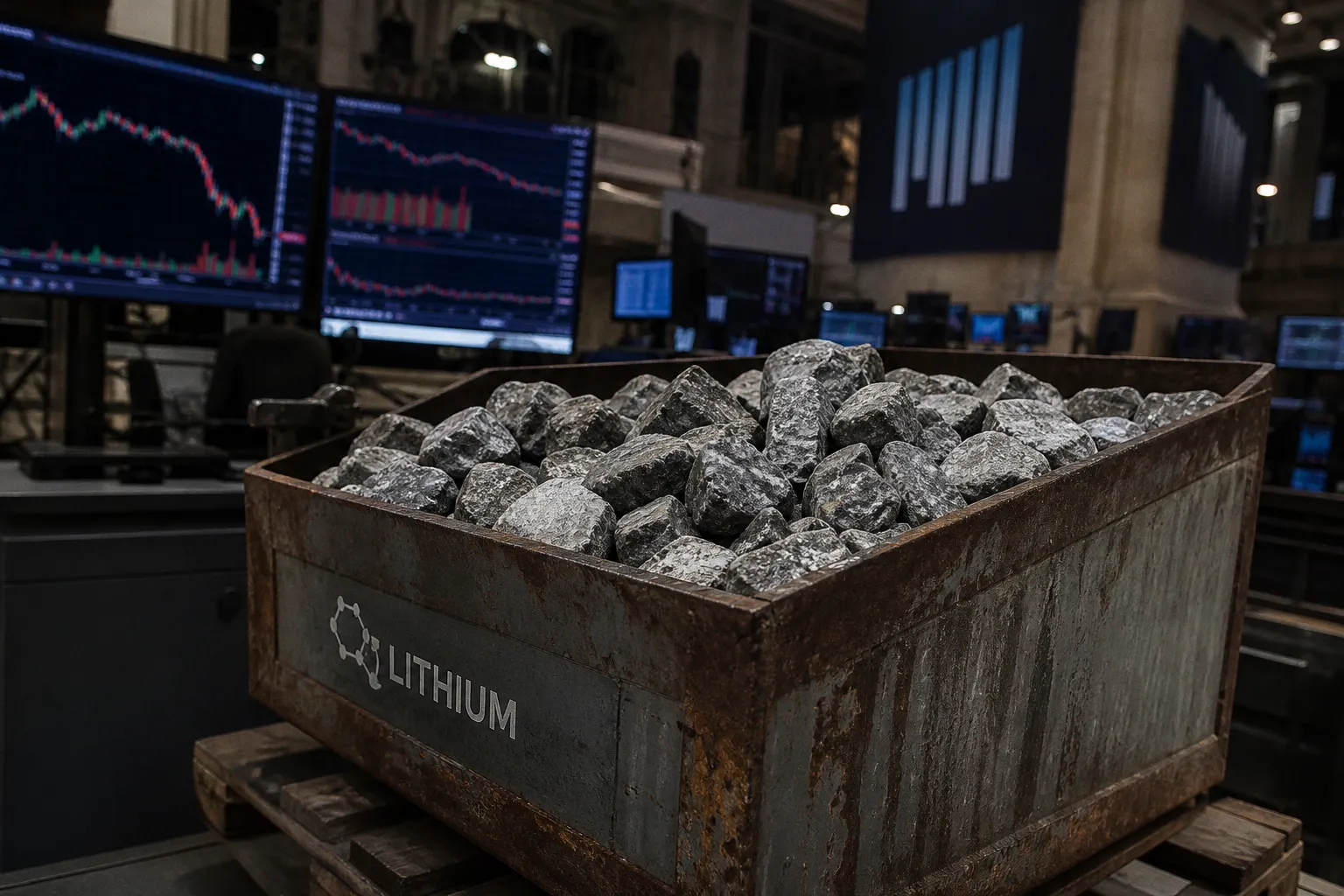
That is the anomaly. Not lower price alone. Lower price plus still-active new supply. Australia. South America. Africa. Projects sanctioned during the 2022 price regime are entering a different tape. The curve has to absorb them without the old gamma.
The surplus is not a headline. It is the structure
The lithium supply surplus is a term-structure problem before it is a narrative problem.
For related context, see Copy trading, social trading platforms and strategies.
In 2022, the market priced conversion capacity, feedstock access, battery-grade qualification, and EV demand growth as one trade. Carbonate moved as if every marginal tonne had the same clearing value. It did not. The squeeze flattened distinctions between brine, spodumene, conversion yield, hydroxide demand, carbonate demand, and cathode chemistry.
By 2024, that compression trade broke.
The lithium carbonate price trend now reflects four mechanics:
1. Inventory moved up the chain. Cathode makers and cell producers have less reason to bid spot carbonate when replacement supply is visible.
2. New mine supply kept arriving. Projects in Australia, South America, and Africa did not stop because the spot market repriced. Capital already committed has inertia.
3. Producer discipline arrived late. Curtailments and delayed expansions began after price damage, not before it.
4. Chemistry shifted the demand mix. LFP growth supports carbonate use, but it also changes the hydroxide premium logic that held during high-nickel cathode optimism.
The result: no clean shortage premium. No broad scarcity multiple. No one-way call option on EV penetration.
The trade moved from “find lithium” to “clear lithium.” That is a different book.
The market is still battery-linked. It is still strategic. It is still part of the industrial metals complex. But the pricing mode has changed. In a squeeze, the marginal buyer sets the tape. In a surplus, the marginal stockholder sets it.
That is why the lithium market outlook has become less about end-demand slogans and more about cost curves, conversion bottlenecks, contract resets, and the pace at which supply responds to spot compression.
From 2022 peak mechanics to 2024 surplus mechanics
The 2022 lithium surge was not just demand growth. It was a duration mismatch.
EV demand repriced fast. Mine supply repriced slow. Conversion capacity repriced unevenly. Battery-grade qualification stayed slow. Buyers needed material inside the cycle. Supply needed capital, permits, construction, commissioning, and yield stability. That gap created the price spike.
Then the spread closed.
By 2024, the lithium market was working through the opposite setup. Supply additions came into a tape with lower spot urgency. Battery makers had more bargaining power. Inventory provided cushion. Producers faced spot levels that forced portfolio review.
That does not mean every tonne is uneconomic. It means the clearing price moved toward the cash-cost stack. The highest-cost units lose optionality first. Expansions become deferrable. Exploration capital gets repriced. Offtake terms become less one-sided.
A simplified structure:
| Market variable | 2022 regime | 2024 regime |
|---|---|---|
| Spot pricing driver | Scarcity premium | Inventory clearance |
| Buyer behavior | Securing tonnes | Timing purchases |
| Producer behavior | Expanding capacity | Curtailing or delaying |
| Project finance signal | Growth optionality | Cost discipline |
| Chemistry signal | Hydroxide growth narrative | Carbonate-LFP mix repricing |
| Curve psychology | Backwardation logic | Surplus carry logic |
The word “surplus” gets used too loosely. In metals, surplus is not just production minus demand. It is available units minus qualified, deliverable, contract-compatible consumption. Lithium adds more friction. Battery grade is not generic. Conversion yields matter. Impurities matter. Customer qualification matters.
Still, the pricing signal is clear. The tape is not paying for theoretical scarcity.
The same macro discount-rate channel also matters. Mining projects and battery supply chains are duration assets. Higher real-rate assumptions reduce tolerance for long-payback expansions. That cross-asset pressure is why the market keeps watching the hawkish shift in the Fed interest-rate outlook even when the immediate lithium balance is driven by tonnes, not policy language.
No need to overstate it. Rates do not mine spodumene. But rates change the strike price on marginal capital.
Curtailments are delta hedges, not a cure
Producer cuts matter. They reduce spot pressure. They also confirm that the prior production path was calibrated to a different price deck.
Major lithium producers have already begun curtailing production or delaying expansion projects in response to lower spot prices and high inventories. That is not a bull signal by itself. It is the market forcing delta reduction.
In derivatives terms, the sector sold too much forward growth into a falling implied-vol surface. Curtailments buy time. They do not erase stock. Delays slow future supply. They do not remove all projects already in commissioning or ramp-up.
The market should separate four actions:
- Hard curtailment. Output is removed from the near-term balance. This has the cleanest spot effect.
- Expansion delay. Future tonnes shift right. The front of the curve gets limited relief unless buyers price future scarcity back in.
- Exploration slowdown. Long-dated supply optionality declines. Relevant for the next cycle, less relevant for current inventories.
- Care-and-maintenance risk. Higher-cost operations become swing capacity. They can cap rebounds if restarted.
The tape does not reward announcements equally. A delayed greenfield project due after the near-term surplus window is not the same as immediate production cuts from a high-cost operating asset. The first changes sentiment. The second changes tonnage.
For lithium carbonate price trends, the difference is critical. Spot carbonate clears against available converted material and buyer appetite. Equity markets may capitalize future discipline. Physical buyers wait for invoices.
Curtailment is not balance. It is a bid for time.
The open question is cost curve opacity. Public producers disclose enough to map broad tiers. Private projects, integrated Chinese converters, and site-level reagent, power, logistics, and recovery assumptions remain uneven. False precision is useless here. The exact 2025 floor is not observable from public data. The market knows pressure exists. It does not know the exact clearing strike.
LFP changes the carbonate trade
Battery-grade lithium demand is not one bucket.
The rise of lithium iron phosphate, or LFP, changes the demand composition. LFP cathodes use lithium carbonate more directly than high-nickel chemistries that rely more on lithium hydroxide. That supports carbonate demand relative to hydroxide in some use cases. But it also cuts against the old premium structure that priced the market around high-nickel EV growth.
The market once treated hydroxide as the higher-growth product because nickel-rich cathodes needed it. That was the long-duration battery trade: longer range, higher nickel, more hydroxide. LFP adoption changed the slope. Cost, safety, cycle life, and mass-market EV positioning pulled more demand toward phosphate chemistry.
For carbonate, this is not one-directional.
LFP growth can increase carbonate offtake. But it can also compress the premium attached to lithium units if the downstream battery market optimizes for cost. LFP is not a scarcity narrative. It is a cost architecture.
That matters for battery grade lithium demand because the marginal chemistry affects the marginal bid:
| Battery chemistry shift | Lithium product impact | Pricing implication |
|---|---|---|
| More LFP adoption | Carbonate relevance rises | Carbonate demand gains support, but cost sensitivity increases |
| Slower high-nickel growth | Hydroxide growth premium weakens | Hydroxide-carbonate spreads can reprice |
| Mass-market EV focus | Buyers resist high input costs | Spot rallies face procurement discipline |
| Regional supply-chain localization | Qualification matters more | Not all tonnes clear at the same value |
The key is not whether LFP is “good” or “bad” for lithium. That framing is too soft. The key is product split. Carbonate and hydroxide do not carry identical optionality. Conversion capacity can move between products only with cost, yield, and qualification constraints.
This is where the lithium market becomes more like nickel than iron ore. Chemistry drives grade. Grade drives customer qualification. Qualification drives liquidity. Liquidity drives price discovery.
A tonne in a feasibility deck is not the same as a tonne in a cathode plant.
Global expansion keeps the surplus alive
The near-term lithium market outlook remains surplus-biased because supply additions continue to enter from multiple basins.
Australia remains central through hard-rock spodumene. South America remains central through brine. Africa adds a project pipeline that was accelerated during the high-price period. These are not identical supply channels. They have different cost structures, ramp profiles, infrastructure constraints, and conversion dependencies.
That heterogeneity does not cancel the surplus. It makes the surplus harder to clear.
Spodumene can respond faster in some cases, but it still needs conversion to battery-grade chemicals. Brine projects can offer scale, but ramp-up and evaporation dynamics are not short-cycle in the same way. African projects may add feedstock into a conversion system already dealing with price pressure.
The supply map creates three pricing layers:
1. Mine gate economics. Ore grade, recovery, strip ratio, reagents, labor, and logistics.
2. Conversion economics. Yield, energy, chemical inputs, waste handling, and battery-grade qualification.
3. Contract economics. Offtake formulas, indexation, floor/ceiling structures, and renegotiation timing.
Spot carbonate sits at the end of that stack. It is visible. It is tradable as a reference. But it is not the whole book.
This is why mining equities can move before carbonate stabilizes. Equity holders price optionality and survival. Physical buyers price delivered material. Credit markets price liquidity runway. Options markets price the probability of gap moves around production updates, policy shifts, and earnings resets.
The industrial metals desk should not treat lithium like a single-line EV demand chart. It is now a multi-leg spread:
- Long qualified carbonate demand.
- Short unqualified feedstock risk.
- Long low-cost producers.
- Short leveraged expansion stories.
- Long optionality on delayed projects if price recovers.
- Short near-term inventory overhang.
That is the trade map. Not the slogan.
Price stabilization requires inventory absorption, not commentary
A lithium carbonate price floor cannot be declared. It has to trade.
The known setup: prices fell sharply from 2022 highs. Producers have curtailed or delayed. Inventory remains high enough to cap spot urgency. New projects continue to add supply. LFP changes the carbonate-hydroxide relationship. The market is projected to remain in surplus near term.
The unknown setup: exact 2025 price floors, exact timing of deficit return, precise cost data for several private producers.
That means the stabilization path has to be read through observable signals:
- Spot stops making lower lows despite weak news. That indicates sellers have less forced inventory.
- Converter margins stop compressing. That shows the midstream is no longer absorbing all pressure.
- Producers cut operating tonnes, not just future capex. That changes near-term balance.
- Contract formulas reset closer to spot. That removes lagged price supports and clears stale terms.
- Inventory drawdowns become visible across the chain. That turns surplus from narrative into measurable depletion.
- Hydroxide-carbonate spreads find a range. That signals chemistry demand is being priced with less distortion.
None of these require a demand forecast with a decimal point. They require tape discipline.
The market has already learned that EV penetration growth does not guarantee lithium price strength. If supply grows faster, price falls. If conversion capacity creates bottlenecks, spreads move. If battery chemistry changes, product premia reset. If inventories sit above the market, spot rallies fail.
That is the current lithium market: not a broken theme, but a broken squeeze.
The options read: where the book is pinned
Lithium is less exchange-standardized than copper or aluminum, but the listed-equity and producer-option complex still gives signal. When spot carbonate falls, miners become convex proxies. Their equity delta rises to carbonate. Their balance sheets become part of the vol surface.
In the 2022 regime, call skew carried the trade. Upside gaps were financed by scarcity. In the 2024 regime, put spreads and balance-sheet hedges matter more. Production updates become event risk. Expansion delays become gap catalysts. Earnings calls become vol events.
The desk should watch three clusters:
| Signal | What it measures | Why it matters |
|---|---|---|
| Producer equity skew | Demand for downside protection or upside calls | Shows whether investors price survival or rebound |
| Short interest and borrow | Stress on leveraged producers | Can create squeeze rallies without spot confirmation |
| Implied vol into updates | Event premium around cuts and capex | Measures credibility of supply response |
A gamma squeeze in lithium equities can occur before the physical market clears. That is not confirmation. It is positioning. If spot carbonate does not follow, equity rallies decay.
The same applies to open interest proxies in related battery-metal names. A large call build into production cuts can generate mechanical buying. But if the cut is an expansion delay rather than current output removal, the move has weak physical backing.
The correct filter is simple: does the event remove near-term tonnes, reduce inventory, or improve realized pricing? If not, it is option flow.
What the glut changes for industrial metals allocation
The lithium glut changes relative-value work inside industrial metals.
Copper still trades grid capex, electrification load, mine disruption, and refined balance. Aluminum trades power cost, smelting capacity, and regional premiums. Nickel trades Indonesian supply, stainless demand, and battery chemistry downgrades. Lithium now trades inventory clearance, project deferral, and carbonate-hydroxide mix.
That makes lithium less useful as a pure EV beta instrument. It is now a spread product.
Against copper, lithium carries more project-supply overhang. Against nickel, it carries cleaner battery demand linkage but similar chemistry risk. Against aluminum, it has less macro inventory transparency. Against cobalt, it has stronger volume growth but more visible supply response from projects funded in the prior cycle.
For portfolio construction, the implication is mechanical:
- Use lithium producers as high-beta expressions of carbonate stabilization, not as broad electrification proxies.
- Separate low-cost operating assets from long-dated developers.
- Treat delayed expansions as long-dated call options, not current balance fixes.
- Track LFP adoption as a product-mix variable, not as a generic lithium demand multiplier.
- Avoid treating 2022 peak pricing as an anchor. It was a squeeze print, not a base case.
This is where many models still fail. They take EV unit growth, multiply by lithium intensity, and apply a fixed price deck. That misses inventories, conversion, chemistry, and producer response. It also misses the curve effect. Surplus markets do not pay full value for future growth when current material is available.
Closing levels: the market needs proof
The lithium market has shifted from scarcity premium to surplus discount. That is the core trade.
The next phase is not about calling an exact bottom. The data set does not support that. The next phase is about identifying when the surplus stops expanding at the margin and when spot carbonate stops clearing below prior reference zones.
Technical focus should remain on:
- Prior spot support zones from the 2024 correction.
- Producer break-even commentary without assuming private cost curves.
- Confirmed output curtailments versus capex deferrals.
- Carbonate-hydroxide spread behavior as LFP share changes.
- Inventory drawdown evidence in downstream channels.
- Options expiry clusters in listed lithium equities around production updates.
A rebound without inventory absorption is a short-vol rally. A rebound with operating cuts, contract resets, and visible stock draw is different.
For now, the tape is simple. The lithium market does not lack a demand story. It lacks a clearing mechanism strong enough to absorb supply built for a prior price regime. Until that changes, the glut matters more than the theme.