Verify American Eagle Silver Coins with 4 Home Tests
The U.S. Mint moved roughly 15.8 million American Silver Eagles in 2024, and that's just one sovereign coin program pouring into a global pipeline already choked with recycled bar stock, dore from…
The Counterfeit Problem Hitting Silver Stacks Right Now
The U.S. Mint moved roughly 15.8 million American Silver Eagles in 2024, and that's just one sovereign coin program pouring into a global pipeline already choked with recycled bar stock, dore from West African small-scale mines, and dubious cast rounds with no assay trail. At the dealer level, the signal is unmistakable: counterfeits are getting better. Base-metal fakes stamped with the Walking Liberty design no longer feel obviously wrong in hand, and high-quality tungsten-core forgeries can fool a basic kitchen scale. If you're buying Silver Eagles — from a local coin shop, an online marketplace, or a private seller — you need a verification routine that doesn't rely on trust alone.
The good news is that.999 fine silver has a set of physical properties that are genuinely hard to fake all at once. Weight, dimensions, diamagnetic behavior, acoustic resonance, and thermal conductivity each offer a separate data point. No single test is bulletproof. But stack four of them together and you build a reasonable physical audit from your kitchen table — no XRF gun required, no Sigma Metalytics machine, no shipping your coins off to a third-party grader.
Here's how each test works, what it actually tells you, and where the limits are.
Precision Measurements: Weight and Dimensions
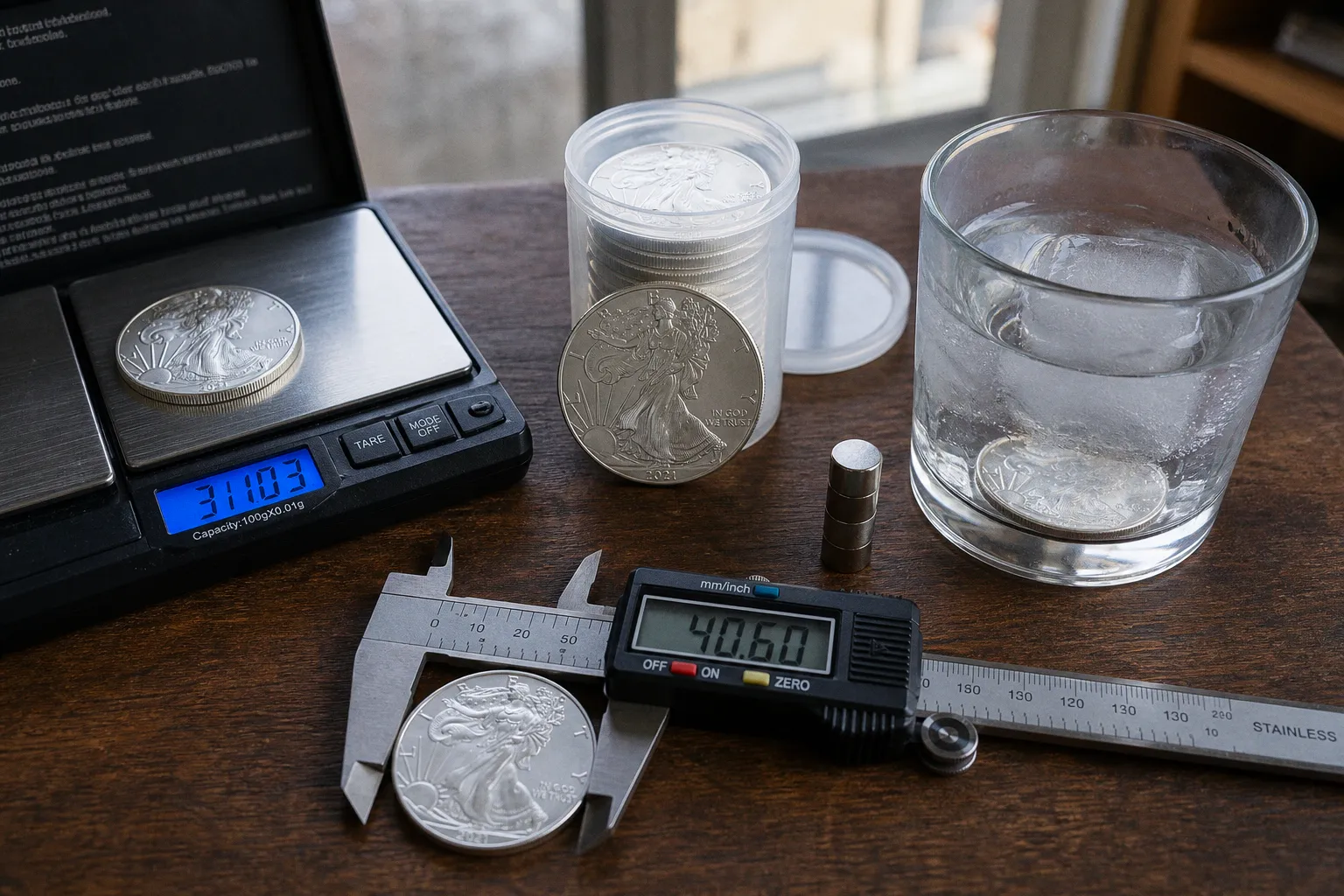
Start with the basics because they're the first line of defense and the cheapest to execute. A genuine American Silver Eagle, regardless of year, carries the same specs the U.S. Mint has held since the series launched in 1986:
| Parameter | Specification |
|---|---|
| Weight | 31.103 g (1 troy ounce) |
| Diameter | 40.60 mm |
| Thickness | 2.98 mm |
| Purity | .999 fine silver |
The critical tool here is a jeweler's scale calibrated to at least 0.01 grams. Digital scales in that accuracy range cost fifteen to twenty dollars and pay for themselves the first time they flag a coin that weighs 29.6 grams — a common tell for zinc or copper-core fakes cast in the correct diameter but coming in light because base metals are less dense than silver.
Dimensional checks matter just as much. A pair of digital calipers will confirm whether the diameter sits at 40.60 mm and whether thickness holds at 2.98 mm. Counterfeiters who nail the weight sometimes overshoot the diameter by a fraction to compensate, and vice versa. The margin of error on a genuine Mint product is tight — within ±0.1 mm on diameter — so a reading of 40.9 mm or 40.2 mm warrants suspicion.
A coin that passes weight and dimensions is in the running. A coin that fails either test goes straight to the reject pile — no further questions.
What this test won't catch: a tungsten core clad in.999 silver foil. Tungsten's density (19.25 g/cm³) is close enough to silver's (10.49 g/cm³) that a cleverly weighted plug can mimic the correct total mass while the outer shell reads authentic on calipers. That's precisely why weight and dimensions are necessary but not sufficient. You need additional physical-property checks to catch the fakes that slip through dimensional screening.
The Diamagnetic Property: Testing Silver with Neodymium Magnets
Silver sits in a specific category of metals: it's diamagnetic. That means when exposed to a magnetic field, it generates a weak repulsive force rather than being attracted. This is fundamentally different from ferromagnetic metals like iron, nickel, and cobalt — the materials most counterfeiters reach for because they're cheap and easy to source.
The test is simple. Place your Silver Eagle on a flat, slightly inclined surface — a paperback book propped at about a 15-degree angle works well. Take a strong neodymium disc magnet (N52 grade, roughly 20mm diameter) and let it slide slowly down the face of the coin.
Here's what to look for:
- Genuine.999 silver: The magnet will move noticeably slower down the coin's surface than it would on a non-metallic surface. You'll feel a subtle, sluggish drag — that's the diamagnetic repulsion working against gravity. It doesn't stick, doesn't snap, but it hesitates.
- Copper or brass fake: The magnet slides at roughly the same speed as on glass. Copper is weakly diamagnetic too, but the effect is less pronounced than silver, and a trained eye can spot the difference in slide rate.
- Steel or nickel-core counterfeit: The magnet grabs and sticks hard. Instant red flag. No further testing needed.
This isn't a precision instrument test — it's a screening method. What it does reliably is eliminate the most common counterfeits, which are made from ferromagnetic base metals. A coin that passes the magnet slide gets to keep going through your verification gauntlet. A coin that sticks or slides too fast gets cut.
Silver doesn't love magnets — it barely tolerates them. A coin that attracts a neodymium magnet with any enthusiasm is telling you exactly what it isn't.
One operational note: the test works best with strong rare-earth magnets, not the refrigerator-magnet grade. Weak magnets produce ambiguous results on genuine coins and give counterfeiters a pass they haven't earned.
Acoustic Resonance: The Ping Test for.999 Fine Silver
Every metal has a characteristic sound when struck — a resonance frequency determined by its atomic structure, density, and elasticity. Silver's acoustic signature is distinctive: a high-pitched, sustained ring that lingers for several seconds. Base metals like zinc, copper alloys, and tin produce shorter, duller tones that collapse into a thud.
The procedure:
1. Balance the coin upright on the tip of your index finger, holding it gently at the rim edges.
2. Tap the coin's edge lightly with another coin, a pencil eraser end, or a small wooden dowel — anything non-metallic that won't mar the surface.
3. Listen.
A genuine American Silver Eagle emits a bright, clear, bell-like tone that sustains for roughly one to two seconds. Experienced stackers describe it as almost musical — the kind of sound that's hard to mistake once you've heard a confirmed genuine coin alongside a base-metal fake side by side. Counterfeits made from silver-plated zinc or copper alloys produce a flatter, shorter sound — more of a clunk than a ring.
The catch is that this test requires a calibrated ear. If you've never heard a genuine Silver Eagle ping, the test loses much of its discriminative power. The fix: pick up one confirmed-authentic coin from a trusted dealer, use it as your acoustic reference standard, and compare every subsequent purchase against it. Side-by-side, the difference is not subtle.
Important caveat: do not use the ping test on proof-finish Eagles. The striking technique can scratch or damage the mirror-like fields that give proofs their premium. This test is for bullion-strike coins only — the kind sitting in tubes and monster boxes, not display cases.
Some apps exist that claim to measure the resonant frequency of coins using your phone's microphone. The technology works in principle — genuine silver resonates at a specific frequency band — but the unknowns are real: no universally standardized frequency range exists for home users without professional-grade equipment, and background noise in a normal room introduces enough variance to make single-digit hertz readings unreliable. Treat app-based ping tests as a supplementary data point, not a verdict.
Thermal Conductivity: The Ice Melt Method
Silver is the best thermal conductor of any common metal — better than copper, dramatically better than steel or zinc. This property is what makes the ice test surprisingly useful for a field check with zero equipment cost beyond a freezer.
Take an ice cube straight from the freezer and place it flat against the surface of the coin. Then place an identical ice cube on a control surface — a ceramic plate, a glass tabletop, or ideally a confirmed base-metal coin of similar size.
Watch the rate of melt. On genuine.999 silver, the ice cube will begin to visibly melt within seconds, drawing heat through the coin's body with remarkable efficiency. The ice on the base-metal control will melt noticeably slower — sometimes dramatically so, especially if compared against a steel or zinc surface.
Silver's thermal conductivity sits at approximately 429 W/(m·K). For context:
| Metal | Thermal Conductivity (W/m·K) |
|---|---|
| Silver | 429 |
| Copper | 401 |
| Gold | 317 |
| Zinc | 116 |
| Nickel | 91 |
| Steel | ~50 |
That gap between silver and zinc — nearly four to one — is what makes this test work. A coin made of a zinc core will transfer heat to the ice cube roughly a quarter as fast as genuine silver. The visual difference in melt rate is not subtle.
Two practical notes. First, dry the coin immediately after the test. Moisture on silver promotes toning — that yellowish or darkened patina that develops over time. A quick wipe with a soft cloth handles it. Second, toning or heavy wear on a coin's surface may slightly insulate the point of contact and reduce the ice melt rate compared to a fresh bullion coin. It doesn't invalidate the test, but it introduces enough noise that you should treat a slightly slower melt on a heavily toned coin as inconclusive rather than damning.
Limitations of DIY Verification and When to Seek Professional Analysis
Here's the part most guides bury at the bottom: none of these four home tests are foolproof on their own.
The combination of weight, dimensional, magnetic, acoustic, and thermal checks will catch the vast majority of counterfeits in circulation — the cheap zinc-cast fakes sold in bulk on auction sites, the silver-plated copper copies, the magnetic-base-metal junk. Against these, your kitchen-table audit is highly effective.
But the industry knows about a different tier of forgery: tungsten-core coins clad in genuine.999 silver. Tungsten's density is 19.25 g/cm³ compared to silver's 10.49 g/cm³, and while they're not identical, a counterfeit constructed with the right proportions of tungsten and silver shell can pass weight, dimensional, and even some magnetic and thermal tests. The acoustic signature shifts — tungsten cores produce a slightly deadened ring — but detecting that difference requires experience and a clean reference coin.
Four home tests filter out the junk. They do not replace professional verification when real money is on the line.
For purchases above a few hundred dollars, or any transaction where the provenance is uncertain, professional-grade tools close the gap:
- XRF (X-ray fluorescence) analysis reads the elemental composition of the coin's surface non-destructively. A two-minute scan at most precious metals dealers will confirm whether you're looking at silver or a silver-plated alternative.
- Sigma Metalytics Precious Metal Verifier sends an electromagnetic wave through the coin and measures the bulk resistivity — a property determined by the metal's internal composition, not just its surface. This catches surface-clad tungsten fakes that fool XRF by presenting a pure-silver face to the detector.
- Ultrasound testing measures the speed of sound through the coin's body. Silver and tungsten transmit sound at different velocities, making this the definitive test for tungsten-core fakes.
The cost-benefit math is straightforward. A Sigma Metalytics verifier runs around $300–400. If you're stacking several thousand dollars' worth of Silver Eagles annually, that tool amortizes quickly against the risk of a single convincing fake slipping into a tube. For smaller positions, most reputable bullion dealers will verify coins at the counter for free or for a nominal fee — and building a relationship with a dealer who runs your purchases through their own verification equipment is, frankly, the single best fraud-prevention strategy available to a retail buyer.
What This Means for the Physical Silver Market
The counterfeiting problem isn't theoretical — it's a logistics issue with pricing consequences. Every fake coin that enters a dealer's inventory costs money to identify and remove. Every buyer who gets burned on a marketplace purchase walks away from the physical market or shifts their allocation toward ETFs and allocated storage programs where the metal sits in a verified vault and never touches the buyer's hands.
That migration matters. Physical retail demand for Silver Eagles — coins, bars, rounds — drives a meaningful chunk of the annual silver offtake. The Silver Institute pegged total physical silver investment demand at over 230 million ounces in recent years. When counterfeit anxiety suppresses that retail channel, it doesn't disappear; it reroutes into paper-adjacent instruments that don't tighten the physical supply chain the same way.
Every fake Eagle that circulates doesn't just defraud one buyer — it erodes the confidence premium that keeps physical bullion markets liquid and independent from paper.
For the stacker buying Eagles for the long haul, verification is not paranoia. It's supply-chain due diligence. You wouldn't accept an unassayed doré bar at a refinery; don't accept an untested Eagle in your safe. The four home tests above give you a credible physical audit for routine purchases. The professional tools close the remaining gap when the stakes justify them. Run the tests, build the habit, and keep your stack honest.