Online gold investing: 5 key methods for beginners
In the first seven months of 2026, gold traced a path that no retail investor should ignore. On January 29, spot reached an all-time high of $5,595.42 per troy ounce. By late June, the same contract traded as low as $3,943.
Online gold investing: 5 key methods for beginners
In between, the metal gave back roughly $1,650 in about 150 trading days — a round trip that would have liquidated any leveraged position and tested the nerve of anyone who thought they understood "safe haven" behavior. As of late July, spot has clawed back to roughly $4,125, while the major bank forecasts for year-end are scattered across a $1,600 range.
That spread — between J.P. Morgan's $6,000 call, Goldman Sachs's $4,900 target, and Bank of America's $4,360 average — is not just analyst disagreement. It is a warning that the instrument you choose to express your view matters as much as the view itself. A beginner evaluating how to buy gold online is, in practice, choosing between five different claims on the same metal: a fintech-app ledger entry, an ETF share certificate, a couriered bar, a vault-stored warrant, or a share in a mining company. Each one behaves differently when the tape reverses.
Digital gold: the convenience that came with a regulator's warning
The pitch is straightforward. Download an app, fund it with a few rupees or ringgit, and own a fraction of a gram of 24-karat gold. Minimum ticket sizes on Indian and Malaysian fintech platforms — ₹100 and RM10 respectively — are lower than any other entry point in the precious metals complex. The metal is marketed as sitting in a "secure vault," fully insured and redeemable in coin or cash whenever the user wants.
That marketing ran into a wall on November 8, 2025. India's Securities and Exchange Board of India issued Press Release No. 70/2025, stating plainly that digital gold products fall outside its regulatory perimeter. There is no investor protection framework, no dispute resolution mechanism, and no segregation requirement enforced by a market regulator. The platforms operate as unregulated sellers of a private liability, not as custodians of allocated metal under a recognized regime.
Digital gold is a fintech promise, not a vault receipt. SEBI's November 2025 advisory made that distinction explicit.
For a beginner in any other market, the absence of a regulator means the absence of recourse. If the issuing platform fails, the customer is an unsecured creditor — behind employees, banks, and tax authorities — in whatever liquidation follows. The "backed by physical gold" language on the app is a contractual representation, not a regulatory fact. The metal may sit in a vault in a third country, insured by a counterparty the buyer has never vetted, under a custody agreement the buyer has never read. Until a major financial regulator in the investor's jurisdiction blesses these structures, treat them as you would any other unsecured retail product: small position size, short holding period, and an exit before the platform does.
Gold ETFs and ETCs: paper gold with a real vault behind it
Gold exchange-traded funds solve the storage problem by outsourcing it. Each share represents a fractional claim on a pool of bullion held by a major custodian — typically HSBC, J.P. Morgan, or a specialist vault operator in London, Zurich, or New York. The metal is, in most cases, allocated: segregated, identified, and auditable. Trading happens through a standard brokerage account during market hours, and liquidity is the deepest in the gold complex outside the spot futures market itself.
The catch is structural. Retail investors cannot routinely redeem ETF shares for physical bars. Physical redemption is reserved for authorized participants — the institutional desks that create and redeem shares in large creation-unit blocks, well beyond any retail position. When you sell your ETF position, you are selling a paper claim to another market participant, not knocking on a vault door.
That distinction matters when the spread between spot and physical blows out. In a normal market, the ETF tracks spot within basis points. In a stressed market — think 2020's COVID dislocation or March 2023's banking scare — authorized participants create or redeem in size and keep the linkage tight. But that mechanism depends on them being willing and able to do the arbitrage. In a scenario where physical metal itself is rationed (refinery shutdowns, sanctions on a major custodian's jurisdiction, freight bottlenecks on bullion airline routes), the ETF can decouple from spot, and the retail holder discovers that their "gold" trades on the liquidity of the secondary market, not on the global price of the metal.
For beginners, the ETF remains the cleanest entry. Low fees, audited metal, a regulated wrapper, easy exit. The price you pay is counterparty exposure to the custodian and the fund's sponsor — and the silent acceptance that you do not, in any operational sense, hold gold. You hold a security that is priced off gold.
Physical gold via online dealers: actual metal, real friction
This is the only category where the buyer leaves the transaction with the thing they set out to buy. Online dealers — the segment the London Bullion Market Association labels Internet Investment Gold — sell bars and coins from refiners on the LBMA Good Delivery list and ship them directly, or store them in allocated vault accounts on the buyer's behalf.
The friction is real and worth pricing in. Dealer premiums over spot for small bars (1 oz, 100 g) routinely run 3–6%. Fabricated coins carry a numismatic-style premium that rarely erodes. Insurance, assay, and shipping on home delivery add another layer. Storage in a third-party vault adds 0.5–1.0% per year in most jurisdictions, plus an entry fee.
A 1 oz bar in your hand is the only instrument in this list where the worst-case settlement is a metal value.
The upside is settlement certainty. If the platform fails, the allocated metal is the buyer's property, not the platform's asset. If the vault operator fails, the metal is segregated from the estate. If the jurisdiction itself deteriorates, the buyer chose the vault and the legal framework in advance — which is why serious buyers think about which country, which vault, and which law before they think about the brand on the bar.
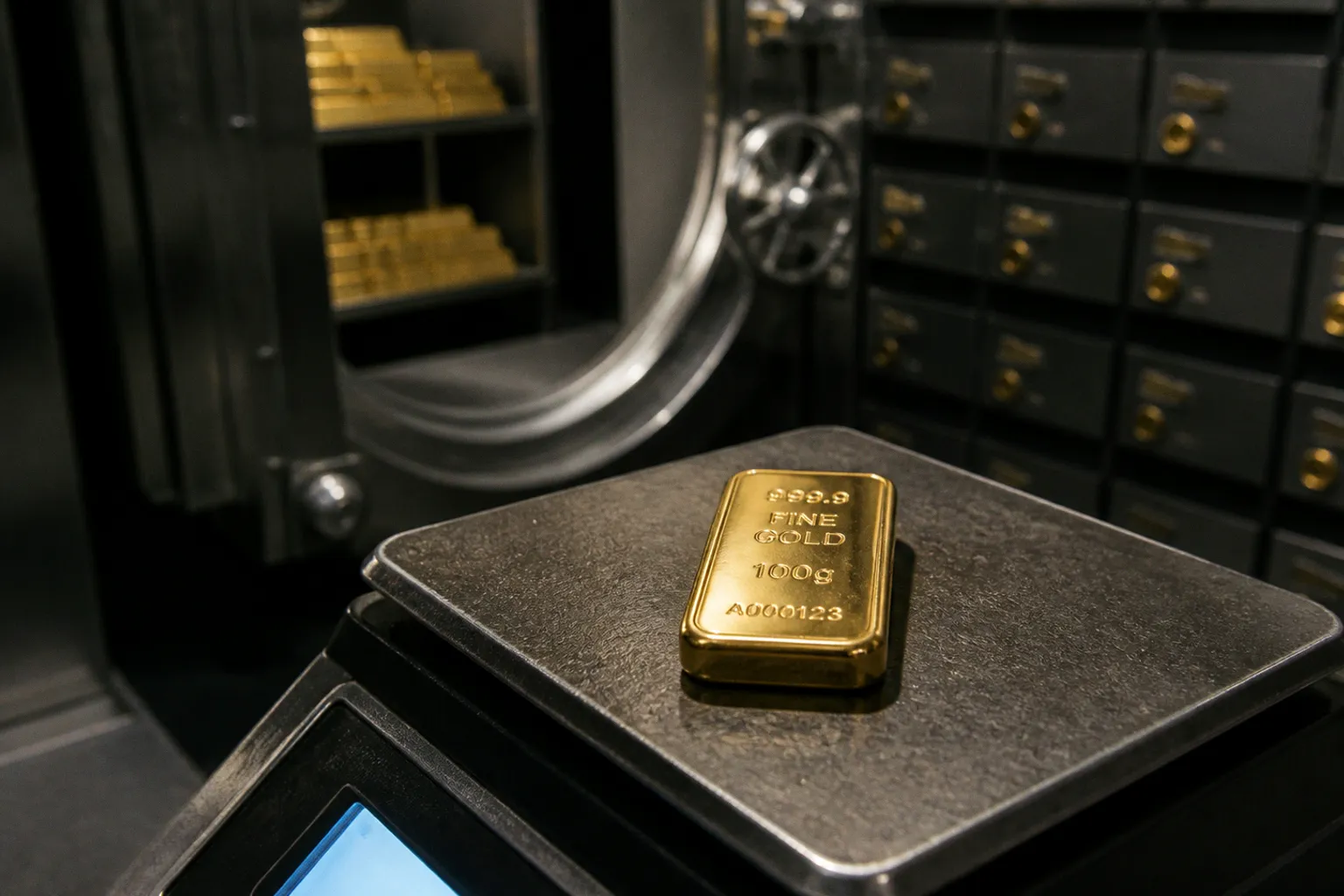
For beginners, the practical entry is an LBMA-affiliated dealer or a US dealer on the major accredited lists, a small bar or a sovereign coin, and either home delivery into a safe the buyer controls or an allocated vault account in a stable jurisdiction. The minimum ticket is higher than an ETF — typically a few hundred dollars — but the position behaves like the metal it represents, which is the entire point.
Gold mining stocks and ETFs: leverage on the spread between cost and price
If the question is the best way to invest in gold online with operational upside, mining equities are the only answer that includes a business behind the position. The arithmetic in 2026 is unusually favorable. With spot oscillating between $3,943 and $5,595 and all-in sustaining costs (AISC) — the fully loaded cost of pulling an ounce out of the ground, including labor, fuel, royalties, and sustaining capital — running below $2,000 per ounce for the major producers, the gross margin at mid-year prices is north of 50%. That is not a financialized number. It is the gap between rock hauled and rock sold.
That leverage cuts both ways. When gold falls, mining margins compress first and hardest. A 20% drop in the metal compresses producer cash flow by far more than 20% once fixed costs are netted out. Operational risks — pit wall failures, smelter bottlenecks, water restrictions, labor stoppages — are absent from every other entry on this list but omnipresent here. Equity-market risk is layered on top: a mining stock can fall 30% in a quarter while gold rises 5%, on guidance or reserve revisions alone. Corporate governance risk is its own category — not every producer publishes AISC the same way, and not every balance sheet survives a multi-year downturn.
Mining ETFs (the major sector funds hold 30–60 producers, weighted by market cap) dampen single-stock risk but not operational or jurisdictional risk. A position in a West African or Central Asian producer still concentrates political, currency, and infrastructure exposure that a basket of North American majors does not. For beginners, the right-sized position is small — the AISC-versus-price margin is real, but it is not a substitute for owning the metal.
2026 price landscape: positioning for a wide range of outcomes
The market beginners are stepping into this summer is not the same market that closed 2025. The January peak was a momentum blow-off; the June low was a momentum flush-out; the late-July recovery around $4,125 is, at best, a base-building exercise. Goldman is calling $4,900 by year-end. J.P. Morgan is calling $6,000. Bank of America is calling a $4,360 average. The honest read is that no one in the sell side knows which band the metal will trade in, and the gap between the highest and lowest forecast is, by any measure, an unusually wide dispersion for a single calendar year — a spread that itself has become a tradable feature of the 2026 tape.
A 5–10% portfolio allocation — the range most institutional strategists currently endorse — can be expressed in any of the five vehicles above. The disciplined choice is to match the vehicle to the thesis. The table below sketches the trade-offs:
| Method | What you actually own | Minimum entry | Typical cost drag | Liquidity | Regulatory wrapper |
|---|---|---|---|---|---|
| Digital gold (fintech) | Unsecured claim on pooled metal | $1–2 | 2–3% spread + storage fees | App redemption | None in India (per SEBI Nov 2025) |
| Gold ETF / ETC | Custodied allocated metal | ~$50 (1 share) | 0.15–0.40% expense ratio | Intraday | Yes (SEC / UCITS / local) |
| Physical via dealer | Allocated bar or coin | ~$200+ | 3–6% premium + storage | Dealer buyback | Consumer law only |
| Mining stocks | Equity in a producer | 1 share | Brokerage + spread | Intraday | Yes (equity regulator) |
| Mining ETFs | Basket of producer equities | 1 share | 0.35–0.50% expense ratio | Intraday | Yes (equity regulator) |
If the thesis is "I want insurance against monetary disorder and I am holding for a decade," physical in an allocated vault is the only instrument that pays you to wait. If the thesis is "I want liquid exposure I can trade around the macro tape," the ETF is the workhorse. If the thesis is "I want operating leverage on the AISC margin," a small mining position sized for drawdown is appropriate. If the thesis is "I want convenience and I am not sure yet," the fintech app is fine — but only with money the buyer is willing to lose entirely if the platform fails.
In a market where spot can move $1,650 in six months, the entry method is the only edge that matters.
The five online methods are not interchangeable. They are five different contracts, with five different custodians, five different regulator regimes, and five different tail risks. The hardest analytical work for a beginner is not picking the entry — it is being honest about which one they are actually buying.