What is commodity futures trading and how does it work?
When a central bank keeps policy restrictive even as sovereign debt burdens continue to compound, the immediate market response is usually framed as a question of yields, currencies, and risk appetite.
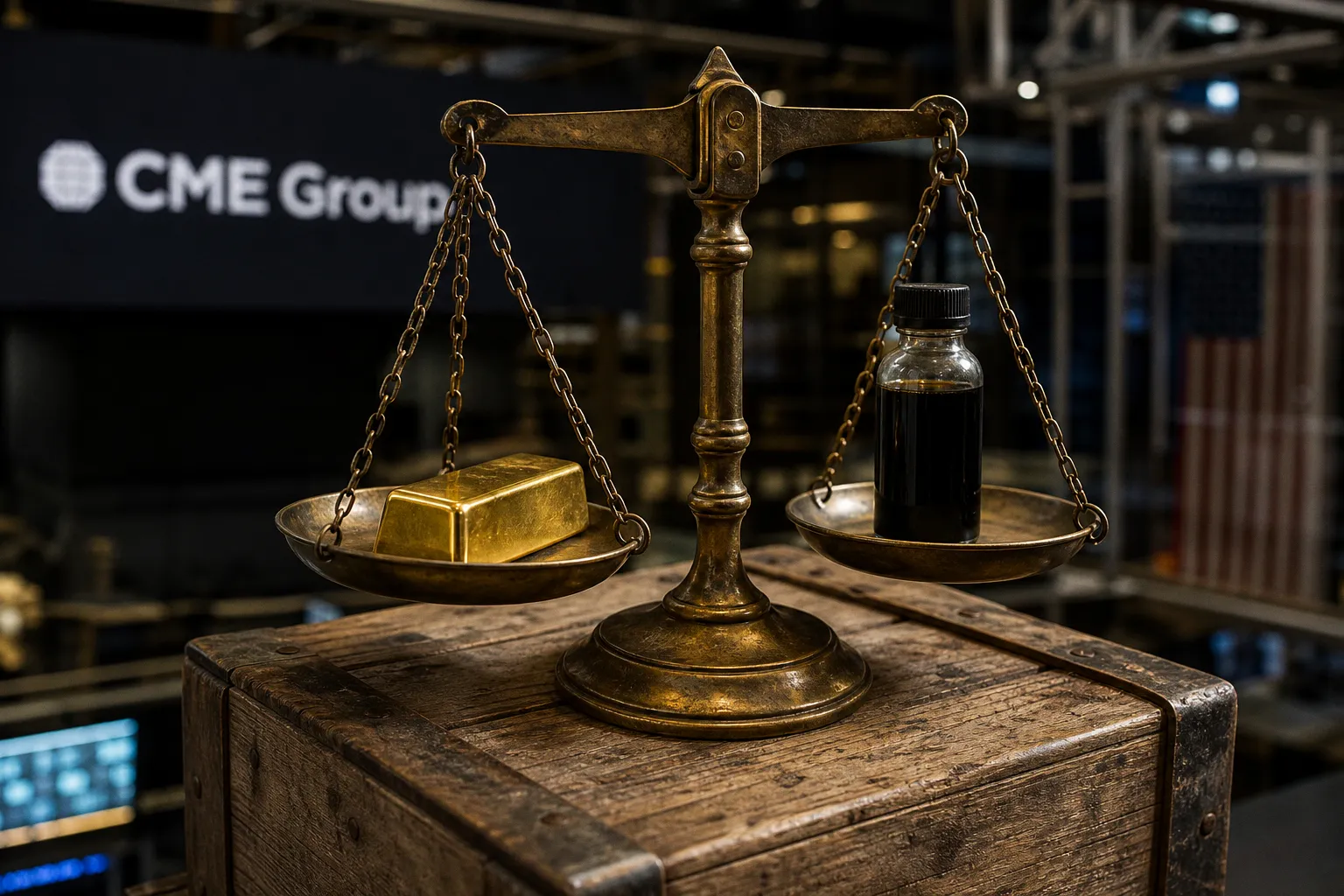
Yet the more durable consequence often appears in commodity futures: producers, consumers, merchants, and financial institutions begin repricing the cost of carrying real assets through time.
Commodity futures trading is the organized market for that repricing. A futures contract fixes the price and quantity of a commodity for delivery or settlement at a later date, while the exchange supplies the standard terms and the clearing house stands between the two sides. What appears, from a distance, to be a wager on oil, gold, wheat, or copper is in fact a highly engineered system for transferring price risk.
The system matters because physical commodity markets cannot wait for monetary conditions to become sensible. A mine must sell output, a refiner must acquire feedstock, an airline must manage fuel exposure, and an industrial manufacturer must price inputs into contracts that may run for years. Futures markets give these participants a common language for doing so: standardized contracts, daily margining, centralized clearing, and a forward curve that translates present uncertainty into tradable prices.
The mechanics of standardized futures contracts
A commodity futures contract is an agreement to buy or sell a specified commodity at a future date, at terms established when the trade is executed. Unlike a bilateral supply agreement, however, the major economic terms are not negotiated from scratch between every buyer and seller. The exchange has already done that work.
A contract specification typically establishes:
- The commodity and its acceptable quality or grade.
- The contract size, such as the quantity of metal, energy product, or agricultural output represented by one contract.
- Delivery months and the last trading day.
- The approved delivery locations or the cash-settlement procedure.
- Price quotation conventions and minimum price fluctuations.
- Position limits, reporting rules, and exchange procedures around delivery.
This standardization is not an administrative detail. It is the foundation of liquidity. A producer seeking to sell exposure in a particular delivery month can meet a buyer who has no commercial relationship with that producer, because both are trading the same legally defined instrument rather than negotiating the peculiarities of a cargo, warehouse receipt, pipeline schedule, or refinery specification.
The consequence is an important distinction: futures trading is related to the physical commodity, but it is not identical to the physical commodity business. A crude oil futures contract, for example, is a standardized risk-transfer instrument. It references a physical market and may provide for delivery, but the overwhelming economic purpose for many participants is managing or assuming price exposure rather than arranging to take a shipment.
Most futures positions are offset before the delivery date. Some contracts permit cash settlement; others contemplate physical delivery under tightly specified exchange rules. The persistent myth that every long futures position ends with trucks, tankers, or warehouses is useful only to those who have never examined a contract calendar.
| Contract feature | What it determines | Why it matters economically |
|---|---|---|
| Contract size | The quantity represented by one contract | Determines the notional exposure and the hedge ratio |
| Delivery month | When the obligation matures | Allows participants to align market exposure with production, inventory, or consumption timing |
| Grade and location | What can be delivered and where | Connects the futures price to a defined physical benchmark |
| Tick size | The smallest permitted price movement | Determines the minimum change in contract value |
| Settlement method | Physical delivery or cash settlement | Defines how residual positions are resolved at expiry |
The futures curve—the sequence of prices across delivery months—then becomes more than a chart. It is the market’s provisional verdict on inventory, financing costs, storage constraints, expected supply, demand conditions, and the opportunity cost of capital. In a world shaped by fiscal deficits and unstable real-rate expectations, that opportunity cost is rarely a trivial variable.
A futures price is not merely a forecast of the spot market. It is a price for transferring uncertainty across time.
Clearing house novation: why the market can function at scale
A futures trade does not leave the original buyer and seller exposed directly to one another’s creditworthiness in the ordinary bilateral sense. Once a trade is matched and accepted for clearing, the clearing house interposes itself through a process known as novation: it becomes the buyer to every seller and the seller to every buyer.
That architecture is among the least visible and most consequential features of commodity exchange basics.
Without centralized clearing, every market participant would need to assess the financial condition of every counterparty, negotiate collateral arrangements, monitor exposures continuously, and prepare for the possibility that a counterparty fails precisely when the market moves violently. Commodity markets have seen enough episodes of violent repricing to understand that this is not an abstract concern. When price volatility rises, credit risk and market risk tend to arrive together.
The clearing house reduces this bilateral web into a managed central structure. It does not abolish risk; no institution can abolish the consequences of a supply shock, a sanctions regime, a crop failure, or a sudden repricing of real rates. What it does is transform counterparty exposure into a system governed by membership standards, collateral, daily settlement, default procedures, and risk models.
The practical sequence is straightforward, even if the institutional machinery beneath it is not:
1. A buyer and seller execute a standardized futures trade on the exchange.
2. The trade is matched and submitted to clearing.
3. The clearing house accepts the transaction and becomes the legal counterparty to both sides.
4. Each side posts and maintains the required margin through its clearing relationship.
5. Gains and losses are settled daily through mark-to-market.
6. The position is either offset, rolled into a later contract month, or carried into the settlement process.
This arrangement allows a commercial hedger to transact with a financial investor, a commodity trading advisor, or another commercial participant without requiring an enduring direct relationship among them. It also explains why exchange rulebooks, clearing member resilience, and margin policy deserve more attention than the dramatic language usually reserved for “market sentiment.”
The exchange is not simply a venue where prices flash across a screen. It is a legal and financial infrastructure for enforcing future obligations.
Margin is a performance bond, not a purchase price
The most common misunderstanding in commodity futures trading concerns margin. Futures margin is not a down payment on the commodity, and it is not the maximum amount that can be lost. It is a performance bond: collateral intended to ensure that market participants can meet the financial consequences of daily price movements.
Because a futures contract represents a large notional exposure, the margin requirement is usually only a fraction of the total contract value. The CFTC describes futures margin as commonly ranging from roughly 2% to 10% of contract value, although the actual figure varies substantially by commodity, contract month, volatility regime, account structure, and broker policy.
That limited initial cash commitment is often described as leverage. The word is correct but insufficient. Leverage in futures is not a feature added for excitement; it is inherent in a system built to transfer the price risk of large physical quantities. A grain merchant or metals fabricator cannot hedge meaningful inventory exposure if every contract requires payment of its full notional value upfront.
CME and other futures markets distinguish between initial margin and maintenance margin:
| Margin category | Function |
|---|---|
| Initial margin | The amount required to establish a futures position |
| Maintenance margin | The minimum account equity that must be maintained while the position remains open |
| Variation margin | The daily gain or loss transferred as the contract is marked to market |
| Margin call | The demand for additional funds when account equity falls below the maintenance threshold |
When an account falls below maintenance margin, funds must generally be restored to the applicable initial-margin level. This daily settlement process is the discipline at the center of futures markets. A loss is not left to accumulate quietly until contract expiry, where it might become a large unsecured claim against a weakened counterparty. It is recognized and settled as the market moves.
That is why margin requirements rise when volatility rises. The clearing system is attempting to maintain adequate coverage against plausible price moves, not issuing a moral judgment about whether a commodity is “too risky.” In CME educational material, the margin methodology is described as targeting coverage of 99% of potential price moves over a period usually equivalent to one trading day. The point is statistical resilience, not price prediction.
The political temptation, whenever commodity prices move sharply, is to interpret the increase in margin as the cause of instability. More often it is the opposite: higher margin is the market infrastructure responding to instability that has already emerged from the physical and macroeconomic environment.
Margin is the daily invoice for holding a view about the future; it does not make the view safer, merely enforceable.
Hedging and speculation are opposite functions of the same contract
The conventional contrast between hedging and speculation is useful, provided it is not treated as a moral distinction. Both functions are necessary to a liquid futures market.
A hedger already has, or expects to have, an exposure in the physical economy. A producer concerned about falling prices may sell futures, thereby reducing the uncertainty of future revenue. A consumer of an industrial input may buy futures to reduce exposure to rising procurement costs. The futures position is designed to offset, at least partially, the price sensitivity of the underlying commercial activity.
A speculator does not necessarily possess the commodity exposure being hedged. The speculator assumes price risk in the expectation of earning a return from correctly assessing market movement, curve changes, volatility, or relative value between contracts. This capital is often criticized in periods of high food or energy prices, usually by observers who want the liquidity but not the participants willing to take the other side.
The distinction is best understood through the balance sheet:
- A producer selling futures is seeking to stabilize future cash flow against a decline in the commodity price.
- A consumer buying futures is seeking to stabilize future input costs against a price increase.
- A merchant using calendar spreads may be managing the relationship between nearby and deferred pricing, inventories, and storage economics.
- A financial participant taking a directional position is accepting outright price exposure that another participant may wish to shed.
- An options buyer pays a premium for the right, but not the obligation, to buy through a call or sell through a put at a defined strike price within a specified period.
Options on futures add asymmetry to the structure. A futures position imposes obligations on both sides unless it is offset or settled. An option buyer, by contrast, has a right without the obligation to exercise; the premium is paid for that flexibility. For a commercial entity facing an uncertain production volume or an uncertain consumption requirement, that distinction can be economically decisive.
Yet no derivative structure eliminates underlying commercial risk with mechanical perfection. The physical exposure may not match the exchange contract’s grade, location, timing, or pricing benchmark. This is basis risk: the risk that the futures price and the actual cash-market price do not move in perfect alignment. It is one reason sophisticated hedging is a continuing process of calibration rather than a single transaction performed at the start of a quarter and forgotten.
The broader point is less flattering to the modern monetary system. Firms hedge because they must make long-duration operational commitments in a price environment shaped not only by supply and demand, but by unstable discount rates, changing currency values, and policy decisions that can redefine financing costs in a single meeting.
Open interest tells you about participation, not destiny
Open interest is the number of futures contracts that remain open at the end of a trading day. It is not the same as trading volume.
Volume measures how many contracts changed hands during a session. Open interest measures outstanding positions that have not been closed, offset, delivered against, or otherwise extinguished. It rises when new positions are created and falls when existing positions are closed.
That makes open interest useful for understanding market participation and positioning conditions, particularly when examined alongside price, volume, spreads, options activity, and the shape of the forward curve. But it is not a directional oracle.
A rise in open interest can coincide with a rising market, a falling market, a commercial hedging program, an institutional allocation shift, or the construction of spread positions that have little to do with an outright bullish or bearish view. Similarly, declining open interest may reflect liquidation, delivery-period mechanics, reduced hedging needs, or a migration into a later contract month.
The more revealing question is not whether open interest is “up” or “down,” but what kind of capital is entering or leaving the market and why.
In precious metals, for example, rising participation can reflect safe-haven flows, changes in real-rate expectations, currency hedging, or positioning around central-bank policy. In energy markets, it may reflect refinery margins, inventory financing, producer hedging, geopolitical risk, or changes in the cost of carry. The same number can describe radically different economic realities.
Commodity Trading Advisors also inhabit this landscape. In the United States, a CTA is an individual or organization compensated for advising others about futures, options on futures, swaps, or certain commodity interests. Registration and membership status establish regulatory obligations; they do not establish foresight, and they certainly do not turn a systematic strategy into a guarantee against loss. Markets are more ruthless than marketing documents.
Futures markets are a scorecard for the real economy
Commodity futures trading works because it converts dispersed uncertainty into standardized, collateralized, continuously repriced obligations. The exchange provides the contract; the clearing house provides the counterparty framework; margin provides daily financial discipline; and hedgers and speculators provide the opposing risk appetites that permit the market to clear.
The deeper significance lies beyond the mechanics. Futures curves absorb the consequences of monetary policy, fiscal deterioration, inventory scarcity, transport constraints, industrial demand, and the perennial mismatch between political promises and real resources. Gold futures may reflect confidence in the purchasing power of money. Energy futures may reflect the cost of maintaining an industrial civilization under changing capital costs. Industrial metals futures may reveal whether the investment cycle is expanding or merely being narrated into existence.
That is why futures should not be reduced to a casino metaphor. Their leverage can be mishandled, their liquidity can thin, and their price signals can be distorted by policy shocks. But the market’s central function remains sober: it forces participants to state, in collateralized form, what they believe a real commodity will be worth at a future date.
In an era when governments can postpone difficult fiscal arithmetic but cannot repeal it, that discipline is rather more valuable than it first appears.