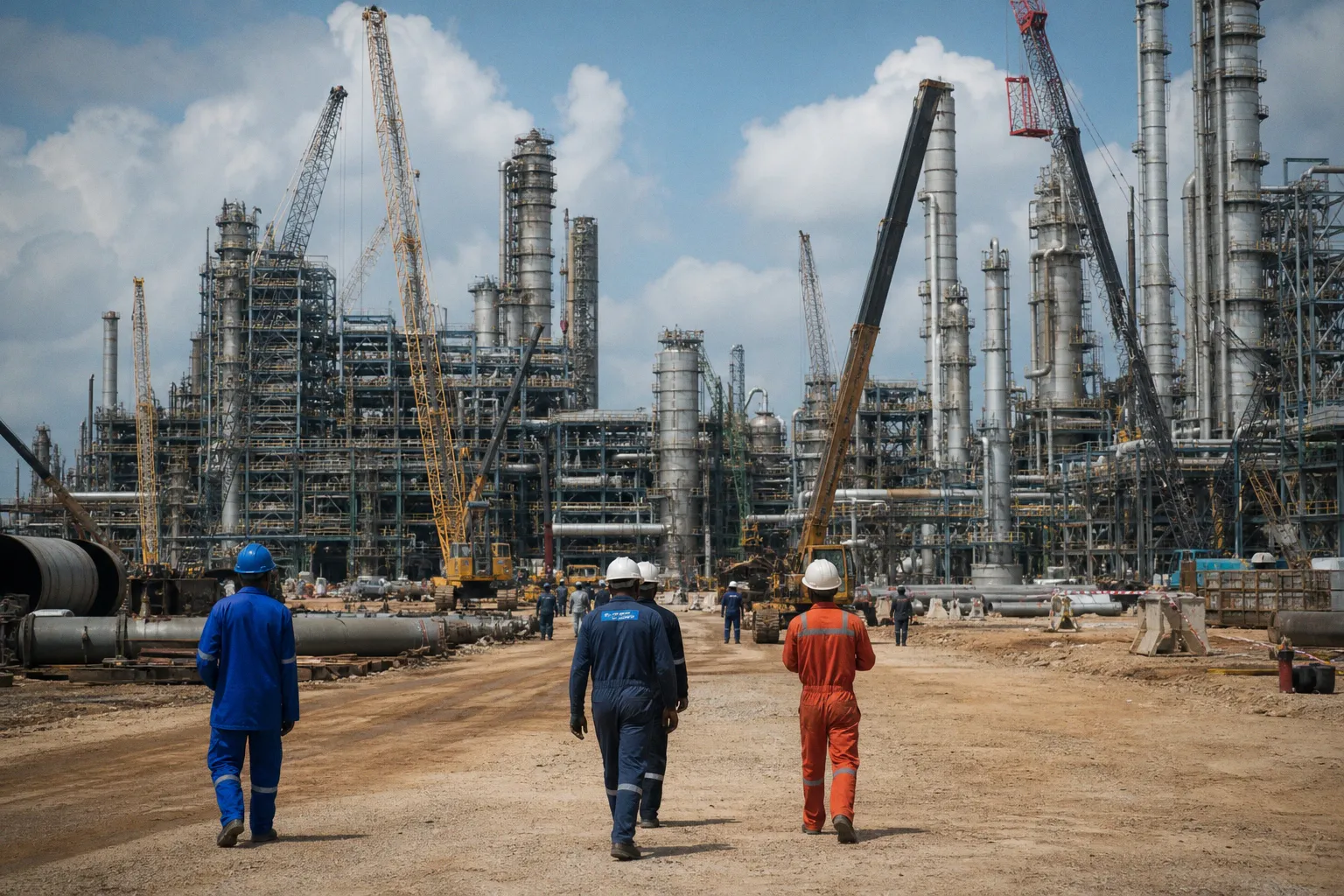
Dangote plans expansion to create world's largest refinery
Capacity expansion in Africa and Asia signals structural shifts in global refined product flows. Dangote plans to build the world's largest refinery; Indian Oil Corporation scales towards 98 million metric tonnes per annum.
Capacity Math & Capital Allocation
Dangote's plan to create the world's largest refinery represents a massive future addition to global distillation capacity. Concurrently, IOCL is deploying ₹75,000 crore ($9B) to lift its own capacity by over 21% to 98.05 MMTPA by December 2026. The Panipat, Vadodara, and Barauni facilities are the targets. IOCL aims to redirect a production surplus from a domestic market consuming ~239 MMTPA against installed capacity of 258.1 MMTPA towards export markets. Current export revenue share is 5%; management targets 15% post-commissioning. The capital intensity focuses attention on debt trajectories and post-CapEx utilization rates as primary margin drivers.
Disruption Event & Supply Volatility
Refinery supply is not a one-way bet. Emirates Global Aluminium restarted its Al Taweelah alumina refinery following an Iranian drone attack, per IndexBox reports. This event injects volatility into regional refined product and feedstock supply chains. Such geopolitical supply shocks create positioning dislocations in related futures contracts. Monitoring refinery outage data and pipeline flows is essential for timing crack spread exposure.
Forward Structure
The forward curve for refined products must now price in two competing vectors: significant new capacity coming online in Nigeria and India versus ongoing supply-chain disruption risks from conflict events. Dangote's project, if completed, would reset Atlantic Basin balances. IOCL's expansion directly challenges Reliance's export dominance in Asia. Traders should track commissioning timelines for these mega-projects against crude tanker rates and global inventory reports. The comparison of volatility between different digital asset classes offers a parallel study in how markets digest competing expansion and disruption narratives.
Positioning data shows open interest in ICE gasoil futures remains elevated. The December 2026 forward contract is a focal point for the IOCL capacity coming online. Gamma exposure near that tenor is a measurable risk for short-vol positions. The key technical level remains the backwardation structure; its steepening or flattening will signal whether the market prices capacity growth or disruption risk more heavily.